OSECI Papers
The OSECI occasional papers deliver piercing, evidence-driven insights into contemporary Islamophobia and its ripple effects across society and Muslim Australian communities. Grounded in rigorous research, the series is indispensable for policymakers and engaged readers who demand clarity, accountability and impact. They offer sharp analysis, real-world implications and a compelling call to action for a more inclusive Australia.
How Can the Healing Begin? Islamophobia, Anti-Semitism & Social Cohesion after Bondi
17 July 2026
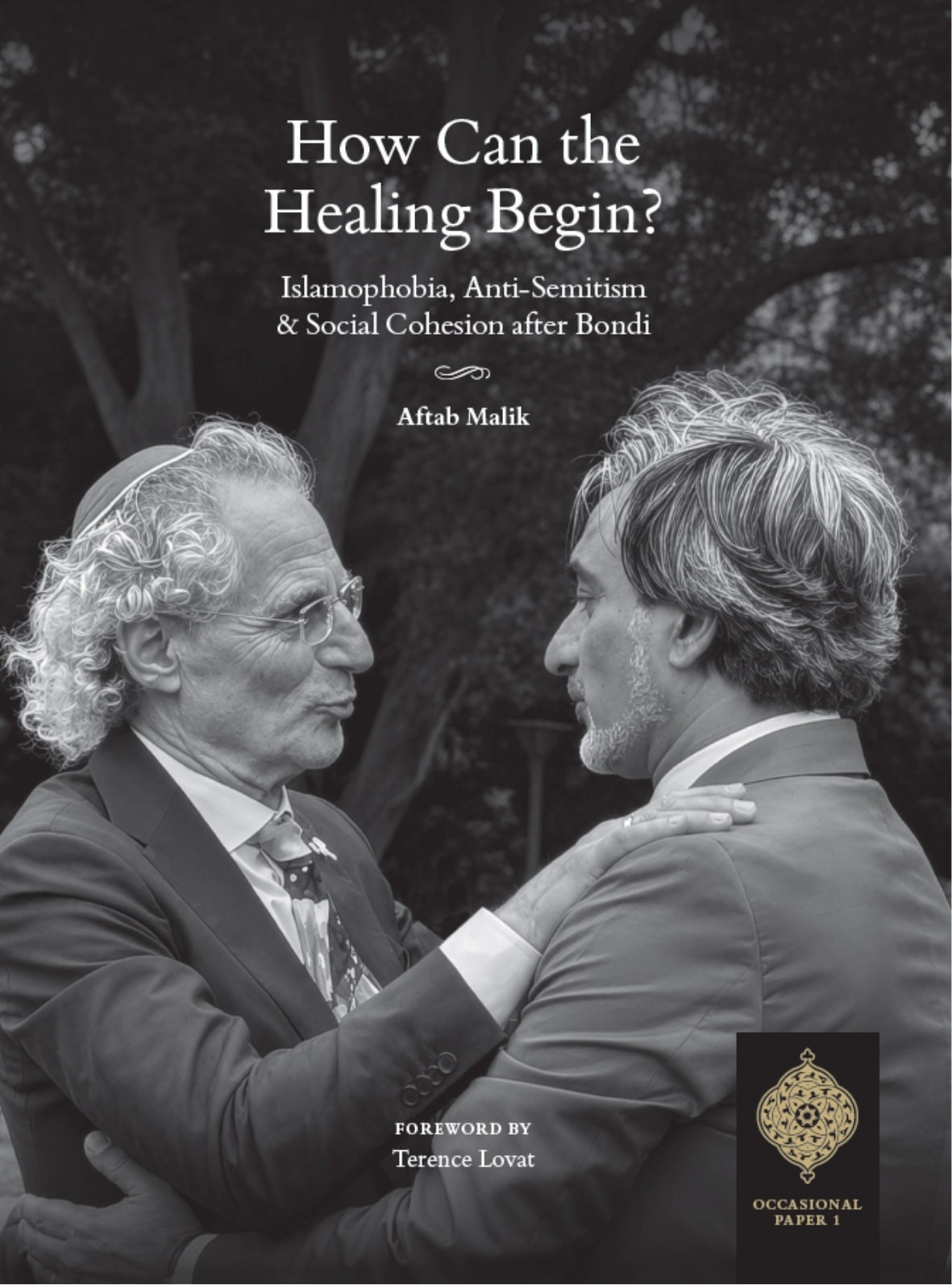
Written in the immediate aftermath of the 2025 Bondi terror attack, this accessible and rigorous essay surveys the terrain of our national conversation. Drawing on Islamic heresiography, social science, history and contemporary research, it offers an authoritative lens on where our society is headed – and how we can understand the forces shaping it.
It provides a clear, grounded defence of Islam’s rejection of extremism and a nuanced examination of how Islamophobia is rationalised, amplified and weaponised in the age of social media.
It warns against the perils of dehumanisation and false equivalences, by making the critical distinction between ISIS-inspired terrorism and legitimate pro-Palestinian political expression, explaining why conflating the two misleads the public and distorts policy.
Finally, it calls for inclusive safeguards, ensuring that any new domestic legislation must shield all communities from hatred and discrimination to preserve social cohesion, or risk deepening a perceived hierarchy of hate.
This is more than an analysis of a moment; it is a path for understanding, resisting and healing in a plural, democratic society.
A definitive resource for policymakers, scholars and citizens committed to a just, fair and resilient nation.
Reviews
“Thoughtful, articulate.” Giridharan Sivaraman, Australian Human Rights Race Discrimination Commissioner
“… an important contribution to a more mature and grounded public conversation that resists simplification and recognises that, even where understanding is possible, deep differences may endure, requiring the patient work of sustaining a shared civic life.” Dr Peter Kurti, Director of Culture, Prosperity & Civil Society program, Centre for Independent Studies
“… speaks clearly and knowledgeably. It shirks nothing. It refuses to succumb to the cheap tribalism or crass zero-sum logic that dominates our public discussions of Islamophobia and anti-Semitism.” Waleed Aly, columnist, broadcaster, author, academic
“… a clear-eyed and deeply researched paper that asks difficult questions of us all as Australians.” David Slucki, Director of the Australian Centre for Jewish Civilisation, and the Loti Smorgon Associate Professor of Contemporary Jewish Life and Culture, Monash University
“This is a wonderfully thoughtful contribution - displaying the very best features of Islam’s long, venerated intellectual history.” Dr Simon Longstaff AO, Executive Director, The Ethics Centre
“… a courageous reflection on Islamophobia, anti-Semitism and the broader challenges to social cohesion in Australia. This work is distinguished by its moral clarity, intellectual honesty and commitment to justice.” Abdullah Khan OAM, President, Islamic Schools Association of Australia (ISAA)
“… a thoughtful and humane reflection on one of the hardest questions facing contemporary Australia: how to begin healing after violence.” Daniel D. Hutto, Senior Professor of Philosophical Psychology, Head of the School of Liberal Arts, University of Wollongong
“Through a measured and evidence-based approach that avoids generalisation and recognises multiple perspectives, the paper focuses on shared humanity, complexity and accountability. It encourages readers to move beyond fear and prejudice.” Dr Bulent (Hass) Dellal AO, Chair, Australian Multicultural Foundation
“Drawing on deep moral reflection, intellectual honesty, and an informed understanding of both the Islamic tradition and Australian public life, Aftab Malik calls for a response grounded not in reactionary rhetoric or collective blame, but in justice, knowledge, compassion, and civic responsibility.” Professor Mehmet Özalp, Executive Director, ISRA (Islamic Sciences and Research Academy) and Head of School, Centre for Islamic Studies and Civilisation, Charles Sturt University
“… this approach will move Australia to a much more inclusive, equitable and prosperous society.” Vivienne Nguyen AM, Chairperson, Victorian Multicultural Commission
“This is an intelligent, balanced, and forward-looking analysis of an urgent and complex issue.” Professor Mohamad Abdalla AM, Founding Director, Centre for Islamic Thought and Education (CITE), Adelaide University