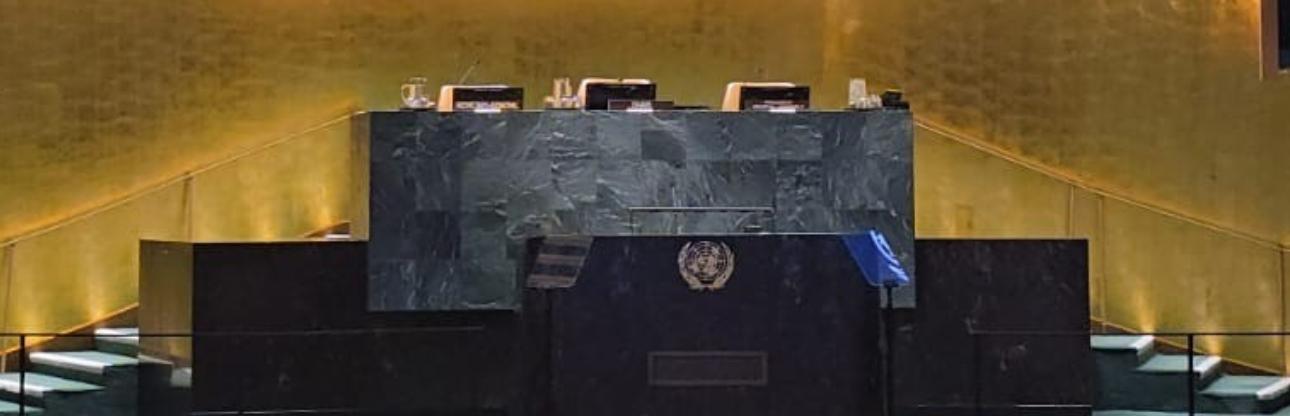
Speech - UN International Day to Combat Islamophobia, 2026
Special Envoy to Combat Islamophobia, Mr Aftab Malik
Thematic Panel 2: From Policy to Practice: deep dive into existing institutional frameworks and National Strategies addressing discrimination based on religion or belief, including Islamophobia and anti-Muslim hatred
Speaker: Mr Aftab Malik, Special Envoy to Combat Islamophobia (Australia)
Introduction: The Mandate of a “Fair Go”
Excellencies, and distinguished guests.
It is really an immense honour and privilege to be invited to speak on this panel.
And for many of you, and let’s be honest probably much of everyone in this room I’ve never met before,, I guess some context would probably be warranted.
So, following an announcement by the Prime Minister of Australia on September the 30th, 2024, I was appointed as Australia’s first ever Special Envoy to Combat Islamophobia. This was not merely a symbolic gesture; it was a historic opportunity to decide who we are as a country – and whether we, as Australians are prepared to take the necessary steps required to ensure every person is safe, valued, and treated with dignity.
Islamophobia in Australia has been persistent – at times ignored, and other times denied –but not fully addressed. Following the 9/11 attacks, it became entrenched, compounded by global and local events. We have seen 20 years of early warning signs: from the Cronulla race riots of 2005 to the horrific fact that an Australian citizen was responsible for the 51 lives taken in 2019 at the Christchurch terror attacks in New Zealand.
The aftermath of the October 7, 2023, attacks served as a catalyst that exposed the deep-seated reality of Islamophobia in Australia, with verified in-person incidents surging by 150% and online incidents by 250% by late 2024.
Most recently, we are responding to an unprecedented rise in Islamophobia following the December 2025 Bondi attack. While reported incidents skyrocketed by 740% in the fortnight that followed the attack, the figure represents only the surface of a deeper "fear of reporting" that has paralysed our community – and that includes a fear of thinking that reporting Islamophobia would be viewed to trivialise the killing of Jewish Australians, and to be seen as competing for sympathy from the public.
This attack saw a rise in the number of mosques receiving threatening and violent letters in addition to being vandalised, Muslim women were being spat at, abused, attacked, harassed, threatened to be killed and raped, and that’s on top of a tsunami of online hate.
Post-Bondi, we saw the emergence of a "naming hierarchy" which weaponised the faith of two Muslim perpetrators responsible for the death of 15 Jewish victims in the attack. At the same time, the Muslim identity of the hero Ahmed Al-Ahmed who stopped one of the Bondi terrorists from further killings, was erased by some of these very media outlets.
The aftermath included what was perceived to be a "performative policing," by many Muslims, when there was a high-profile arrest of a group of young Muslim men who followed the attack, but they were soon released without charge or media fanfare. This viscerally reinforced the "Muslim-as-suspect" trope and eroded community trust. It is this very environment of suspicion that is exacerbated by political incitement, such as Senator Pauline Hanson’s recent claim that there is "no such thing as a good Muslim," and making Muslim majority areas and neighbourhoods unsafe for everyday Australians.
These incidents have a cumulative impact: each impact reinforces a sense that Muslim identity is not welcome, nor part of Australia’s social fabric. This has the immense danger of reducing institutional legitimacy and fraying social cohesion.
My appointment as Special Envoy was a direct response to this persistent and long-ignored prejudice, formalising a structural commitment to move beyond denial.
From Evidence to Accountability: The 54 Recommendations of a National Framework to Combat Islamophobia
I commenced my role by listening. I met with more than 100 individuals – mothers, students, teachers, and community leaders – academics, professionals, specialists and representatives of peak bodies. They verified that Islamophobia is not only interpersonal; it is institutional and structural, affecting every part of life.
Based on these conversations, as well as consultations with global experts on Islamophobia, I produced a 54-point strategic framework for the inclusion, safety, and prosperity of Muslims in Australia. And this is very unashamedly plugging it but I do have some copies if anyone is interested – they’re free, so I’m not selling them, it’s all good.
So, my framework is built on four non-negotiable pillars:
- First, Accountability and Responsibility: Holding individuals and institutions accountable for hate speech and discriminatory actions and policies.
- Second, providing Protection and Support: by ensuring the victims of Islamophobia have accessible support services, and that communities feel safe and valued.
- Third, through Education and Awareness, challenging Islamophobia, promoting understanding and respectful dialogue through training, media and the arts.
- And finally, Building Social Cohesion by building trust, encouraging positive interactions, intercultural exchange, and collaborative efforts to reduce prejudice whilst fostering mutual respect.
While visible solidarity and clear condemnations of Islamophobia matter, my National Strategy makes a simple argument: addressing Islamophobia requires structural reform, not a communications response.
Strategic Action: 2024-2026 (Activities of OSECI to date)
In my first 16 months, I have focused on a transition from evidence to systemic action:
I am pushing for systemic legal reform, by challenging policies that entrench bias, specifically by advocating to the Independent National Security Legislation Monitor (bit of a mouthful of a name) to decouple "religion" from the legal definition of terrorism.
I am also launching a range of preventative measures starting with education. My office has equipped 2,200 school principals with the knowledge to detect and stop Islamophobic bullying.
To support evidence-based policies and practices that protect Muslim communities, we are launching soon, a national reporting campaign to capture the full scope of the problem in incidents, and hopefully overcoming the "fear of reporting" that masks the true scale of harm against Muslims in Australia.
We are fortifying online safety, embedding protection into the daily lives of Muslims through real-time collaboration with Meta to disrupt digital hate.
The 2026 Horizon: Responding with Resolve
Moving into the remainder of 2026, my office is shifting from foundational establishment to a strategy of quantification and structural reform. My vision is centred on building a rigorous evidence base to drive systemic change across key governmental agencies, as well as judicial, media, and social sectors.
We will focus on Data-Driven Reform, launching a nationwide reporting campaign alongside two landmark longitudinal tools: the Australian Islamophobia Index, to identify, diagnose, measure and target the drivers of anti-Muslim attitudes, as well as the Australian Muslim Poll, to evaluate shifting levels of safety, belonging and priorities of Muslim communities in Australia.
To better understand the impacts of Islamophobia and how to detect it we are working to offer specialized anti-Islamophobia training to all senior executives across the Australian Public Services. In support of the legal rights of Muslims in Australia, we hope to provide training to ensure legal practitioners understand the mechanics of Islamophobia in their practice.
We are working closely with universities and schools to explore ways to improve literacy on Islam and Islamophobia, reporting mechanisms, and embed a culture of learning and critical thought.
We will ramp up media accountability, monitor Islamophobic media coverage, and amplify the Muslim community’s voices in mainstream media.
We will empower local governance and communities, engaging local council peak bodies to ensure that grassroots services delivery, meets the specific needs of Muslim communities, whilst simultaneously empowering local community and national leadership to combat Islamophobia through evidence-based approaches.
We will be rolling out a national, eight-month community-centric series of conversations to overcome the common tropes and stereotypes about Muslims and Islam, partnering with local churches, community halls, youth centers and libraries.
Most importantly, all efforts will be underpinned by a robust Monitoring, Evaluation, and Learning (MEL) framework to ensure our findings are shared and the impact is measurable, replicable and scalable while we work together to combat Islamophobia in the various manifestations at various scales.
Closing remarks
We all know that Islamophobia is an extreme danger for social cohesion. It creates disengagement and disenfranchisement. It spreads fear and creates ‘us vs them’ social dynamics. Ultimately, it undermines how our democracy functions.
We must learn from one another globally to act more precisely locally, ensuring that our interventions respect the nuances of how Islamophobia is negotiated in the diverse spaces of our national contexts.
And with that in mind, based on these experiences, I will be generous with our findings and in our experience. Through our robust impact framework, my office is committed to exchanging our learnings, scaling our collective efforts, and working together to ensure our response is as principled and determined as the problem itself.
As we move forward, let our coordination be global, and our solutions be as localised and diverse as the communities they seek to protect from the real and imminent threat of Islamophobia.
Thank you very much.
Watch the full speech on UN Web TV, skip to (02:20:13 to 02:32:25): Addressing Islamophobia and Discrimination Based on Religion or Belief -- the Nexus to Human Rights | UN Web TV