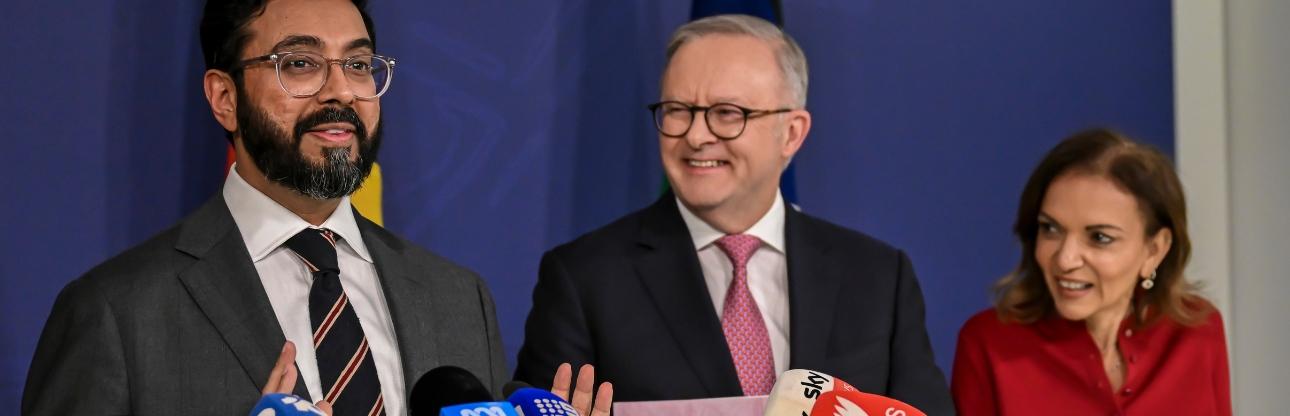
Launch speech – Recommendations to the Prime Minister
Special Envoy to Combat Islamophobia, Mr Aftab Malik
Thank you, Prime Minister.
I’d like to begin by acknowledging the Traditional Owners and Custodians of the land on which we meet today, the Gadigal people of the Eora Nation, and pay my respects to their Elders, past and present.
I express my sincere thanks to the many individuals from across Australia who made this work possible — mothers, daughters, community leaders, imams, academics, civil society organisations, youth leaders, all of whom offered their trust, time and experience with me.
I extend my gratitude to the Prime Minister for commissioning this role, which reflects the government’s commitment to combating Islamophobia.
I would like to thank Ministers Burke and Aly, who have always offered their support and encouragement.
Today marks a critical and long-awaited moment for the Muslim communities of Australia.
This is a historic opportunity.
It is a moment where we decide who we are as a country — and whether we are prepared to take the steps required to ensure that every person in Australia, regardless of faith, ethnicity or background, is safe, valued and treated with dignity.
The reality is that Islamophobia in Australia has been persistent — at times ignored, at other times denied — but never fully addressed.
We have seen opposition to mosques and Islamic schools turn to violent vandalism and assaults on Muslim properties.
We have seen public abuse, graffiti, and assaults of Muslims. We have seen women and children targeted, not for what they have done, but for who they are and what they wear.
In the past week alone, we had a fake bomb left outside a Gold Coast mosque, and 1700 students evacuated from Queensland’s largest Muslim school, due to a bomb threat.
Here in Sydney, the Islamophobia Register recorded an alleged incident in which a 55-year-old Arab man was repeatedly punched in the face while waiting at a bus stop. This was after the assailant allegedly targeted another Muslim passenger with Islamophobic slurs.
These are the consequences of leaving Islamophobia unaddressed.
Islamophobia has intensified over the past two decades.
Following the September 11 attacks in 2001, it became entrenched, compounded by global and local terror attacks, narratives in certain sections of the media, and both Islamophobic and inflammatory statements from some of our parliamentarians.
The impacts of Islamophobic rhetoric were demonstrated in the Cronulla riots of 2005.
Violence, assault, vile racism and derogatory statements written into the sand of the beach, and on the bodies of rioters pushed the overt message that Australian Muslims and Arabs were not welcome here.
This is a history we cannot repeat.
In 2019, it was an Australian citizen who was responsible for killing 51 Muslims in their place of worship in the Christchurch terror attacks.
That fact alone should compel us to act.
Since October 7, 2023, Islamophobic incidents have skyrocketed.
The Islamophobia Register recorded a 150% increase in verified reports of in-person Islamophobic incidents by November 2024.
Online, these incidents increased by 250% compared to any other reporting period.
Despite these spikes in reports, Islamophobia remains under-reported, with far more intensity than what these troubling numbers tell us.
But this phenomenon is not new. The data and evidence on Islamophobia is consistent — and it is troubling.
In 2019, the Christchurch terror attacks led to a fourfold increase in Islamophobic incidents in-person, and an eighteen-fold increase online in Australia.
A 2020 study found that 41 per cent of mosques in Sydney, 70 per cent in Melbourne, and 89 per cent in Brisbane had experienced attacks or threats.
By 2022, Muslims were rated as being the most negatively viewed group by religion, among Australians surveyed in the Scanlon Mapping Social Cohesion report. And most recently, the Scanlon Institute reported that one in three Australians — 34 per cent — express negative attitudes toward Muslims, a rise from 27 per cent the year prior.
These attitudes have real and unacceptable consequences.
Muslim women, in particular, face the brunt.
Many are physically assaulted, spat on, shoved, or subjected to sexual threats — simply for wearing a headscarf.
In a repulsive incident recorded by the Australian Human Rights Commission, a man told a Muslim couple on a train that he would “love to kill” their three children — all under the age of ten.
This is unacceptable.
During my national listening tour late last year, I met more than 100 individuals — parents, students, professionals, representatives of peak bodies, religious leaders, and community organisers.
I listened to their experiences of exclusion, isolation, and disenchantment.
The evidence aligns with what Muslim communities of Australia shared with me - Islamophobia is not only interpersonal.
It is also institutional and structural. It affects Muslim students, and professionals, opportunities for employment, accessing services, and interactions with law enforcement. It affects every part of life.
We know that global events significantly fuel Islamophobia, as they foster narratives that associate Islam with terror, violence, and cultural and civilizational threats.
The 9/11 terror attacks, Bali, Charlie Hebdo, the Syrian refugee crisis, the Christchurch terror attacks, the list goes on.
In the wake of the 7 October attacks, the Islamophobic spike that followed has arguably been driven by anti-Palestinian hate and racism, which makes no distinction between Muslim and Arab, Islam or Christianity. The fury of this prejudice, blinds perpetrators to view all Arabs as Muslims, and all Muslims as terrorists, and terrorist sympathisers.
For some Australians, the severity of what I am presenting today may come as a surprise, for it challenges the understanding that Islamophobia is understood only as attacks on Muslim women and Islamic institutions. Islamophobia is not always overt or violent. The issue is not a lack of evidence but a lack of action.
The recommendations I present today emerged from a combination of Muslim lived experiences in Australia, the input of 30 national and international experts and academics, as well as the only two other Envoys in the world, solely committed to combating Islamophobia.
Together, we have provided a strategic framework to address all these concerns through achievable, robust, and practical actions.
It proposes a way forward for the religious protection of all religious communities, who have not been afforded this to date.
And, as you will see in the framework that is now available from my website: oseci.gov.au, it aligns with the National Anti-racism Framework developed by the Australian Human Rights Commission.
I have made 54 recommendations, spanning every major agency in the Australian Government.
The recommendations encapsulate four key areas:
- Accountability and Responsibility
- Holding individuals and institutions accountable for hate speech and discriminatory actions and policies.
- Protection and Support
- Ensuring that victims of Islamophobia have accessible support services, and that communities feel safe and valued.
- Education and Awareness
- Challenge Islamophobia, promote understanding and respectful dialogue through training, media, arts, and education.
- Building Social Cohesion
- Build trust, encourage positive interactions, intercultural exchange, and collaborative efforts to reduce prejudice and foster mutual respect.
These recommendations aim to engender a fair, respectful, and inclusive environment—one that actively combats prejudice and hate but importantly respects fundamental freedoms.
In conclusion, I present these recommendations as an independent submission to Government.
This report demonstrates that Islamophobia remains a deeply ingrained societal challenge. And as such, will require it to be confronted with equal urgency to other discriminatory practices.
This prejudice undermines our core values of mutual respect, fairness and compassion. It also disproportionately disenfranchises Muslim Australians, who are not asking for special treatment, but equal recognition of harm. To do so, will require the government to “act with empathy, courage and resolve,” as Usman Khawaja writes in his foreword to the report.
Throughout the drafting process, I have sought to appeal to the enduring Australian ethos of “a fair go for all.”
It is this conviction that underpins my appeal for collective effort and responsibility.
Not too long from now, I hope we look back at this historic moment and see this as the turning point for addressing Islamophobia … and turning words into meaningful action.
Thank you.